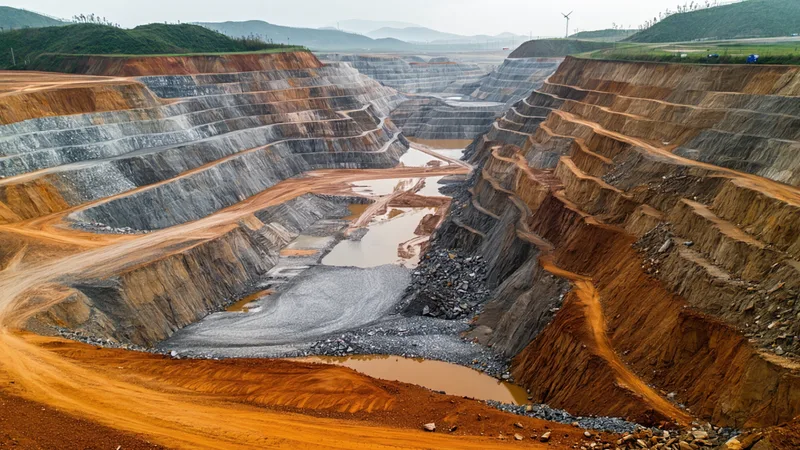
The Surveyor Who Stopped Walking the Pit
At a mid-size aggregate quarry operation in 2023, the survey team's standard procedure for stockpile volume measurement was a two-day affair: a licensed land surveyor plus one assistant, total station setup at three control points around the active stockpile area, manual offset rod measurements at a grid density that varied based on terrain complexity, data entry into the survey software, and a volume calculation that was delivered to the operations team the following week. This was repeated monthly — or more frequently when inventory reconciliation required fresh numbers. It was accurate to within 2–3% and consumed roughly 16 labor-hours per monthly cycle.
By late 2024, the same quarry was running four-drone grid surveys of the full stockpile yard in under three hours, producing orthomosaic and DSM output with sub-5 cm accuracy, with processed volumetric data delivered before end of business on the same day. Total field crew time: two people, half a day. The surveyor is still employed — they're reviewing the drone-derived data, managing the GCP network, and running QA on the processing pipeline rather than walking measurement grids in a hard hat and safety vest in July heat.
This transition is real and it's happening at quarries, open-pit mines, and bulk material storage yards across the industry. But the details of how it's done operationally — the mission design choices, the processing pipeline requirements, the accuracy validation protocols — are worth understanding for operations directors considering the shift.
Why Stockpile Measurement Is a Natural Fit for Multi-Drone Photogrammetry
Stockpile volume measurement has characteristics that align well with what drone photogrammetry does best. The survey targets — material piles — are typically large enough to cover with a grid survey at efficient flight altitude (30–60m AGL for aggregate and ore stockpiles), visually distinct enough for reliable photogrammetric point matching, and don't have the dense vegetation or fine surface texture that can degrade photogrammetry accuracy. The deliverable — a DSM (Digital Surface Model) and an orthomosaic — is well within standard photogrammetry processing capabilities.
The volumetric calculation itself is mathematically straightforward once the DSM is produced: compare the current surface elevation to a base reference surface (the surveyed ground plane underneath the stockpile) and integrate the volume above the reference. Most photogrammetry processing tools include volumetric calculation as a built-in function. The challenge isn't the calculation — it's the accuracy of the surface model that feeds it.
Accuracy Requirements and Ground Control Point Strategy
The volumetric accuracy of drone-derived stockpile surveys depends primarily on three factors: the accuracy of the ground control point (GCP) network, the flight altitude and resulting ground sampling distance (GSD), and the photogrammetric overlap and sidelap of the flight plan.
GCP Networks in Active Mining Environments
Ground control points are the GPS-surveyed reference markers that anchor the photogrammetric reconstruction to a real-world coordinate system. Without GCPs or equivalent RTK/PPK positioning, photogrammetry reconstructions can have absolute positional errors of 1–5 meters — which produces volumetric errors of 5–15% on large stockpiles and makes the data useless for inventory reconciliation.
Setting up a GCP network at an active mining site introduces operational challenges: GCPs need to be placed where they can survive haul truck traffic cycles and periodic ground disturbance, they need to be visible in the aerial imagery (typically 40×40 cm checkerboard or X-pattern targets), and they need to be GPS-surveyed with RTK accuracy before each flight cycle or their coordinates verified against a permanent benchmark network. Many programs resolve this by installing permanent GCP monuments in areas outside the active stockpile zone and supplementing with portable targets placed before each survey flight.
RTK-equipped drone platforms (GPS base station + RTK receiver integrated into the aircraft) and PPK processing (post-processed kinematic positioning from a base station log) reduce the reliance on dense GCP networks for absolute accuracy. Some operations have moved to 2–4 checkpoint GCPs for verification rather than 8–12 GCPs for primary position control, with RTK handling the primary georeferencing. This reduces survey setup time significantly but requires that the RTK system's accuracy be validated against a known survey benchmark at each flight.
Flight Parameters for Volumetric Survey
For aggregate and ore stockpiles where the deliverable accuracy target is ±1–2% volumetric, the following flight parameters represent current industry practice:
- GSD: 2–4 cm (achievable at 30–50m AGL with most 20 MP drone cameras)
- Forward overlap: 80–85%
- Side overlap (sidelap): 70–75%
- Flight pattern: Grid with optional oblique passes around steep stockpile faces to improve surface reconstruction at high-slope angles. Steep pile faces (>40° angle of repose) are the most common source of reconstruction artifacts in stockpile photogrammetry.
Flying a single orbit at 45° gimbal angle around each stockpile's perimeter — after the nadir grid pass — significantly improves reconstruction accuracy on the pile flanks. This adds 10–20 minutes per major stockpile but substantially reduces the "shadow zone" artifacts that appear in nadir-only surveys of steep-sided piles.
Multi-Drone Operations for Stockpile Yards
A large aggregate or ore stockpile yard may contain 15–40 individual stockpiles spread over 20–80 acres. A single drone running sequential grid surveys of each stockpile could take 6–8 hours for a full yard cycle — which may be acceptable for a monthly survey cadence but is impractical for weekly or on-demand measurement needs.
Multi-drone operations address this by running parallel surveys: each aircraft is assigned a designated set of stockpiles or a geographic sector of the yard, with altitude band assignments that prevent airspace conflict between adjacent aircraft. A four-aircraft fleet running simultaneous sector surveys can complete a full yard cycle in 90–120 minutes, with the added benefit that processing can begin on the first aircraft's data while the remaining aircraft are still flying.
The mission planning requirements for multi-aircraft stockpile surveys are different from single-aircraft corridor planning. The individual stockpile survey missions are shorter — typically 8–18 minutes per stockpile depending on size — which means the transition between missions (survey complete, aircraft returns to launch, new mission uploaded, aircraft departs) happens more frequently. Smooth sequencing of these transitions, with minimal dead time between missions, is where multi-aircraft throughput gains actually materialize. An aircraft sitting at launch waiting for the operator to load the next mission file is not flying.
Processing Pipeline for Volumetric Deliverables
The processing pipeline for stockpile surveys has a specific structure that differs from general-purpose photogrammetry workflows:
- Image ingestion and quality check: Verify image count matches expected mission output, check for blurry or overexposed images, confirm GPS/EXIF metadata is present and consistent with planned flight path.
- Alignment and dense cloud generation: Standard photogrammetric pipeline (image alignment, dense point cloud generation). For stockpile surveys, aggressive downsampling is usually not appropriate — dense cloud quality directly affects volumetric accuracy.
- GCP registration: Identify GCP targets in images, assign survey coordinates, register the reconstruction. Verify residuals are within acceptable tolerances (typically <1.5 cm RMS for each GCP in a well-controlled survey).
- DSM generation: Build digital surface model at processing resolution appropriate for deliverable accuracy requirement.
- Volume calculation: Define base surfaces (ground planes under each stockpile, typically from a previous bare-ground survey or engineering design drawings), calculate cut-fill volumes above base surface. Assign material type if the yard contains multiple product grades in segregated stockpiles.
- Report generation: Stockpile-by-stockpile volume report with change from previous survey period, total yard inventory, and anomaly flags for stockpiles where volume change exceeds expected production parameters.
End-to-end, this pipeline takes 2–5 hours per aircraft-day of survey data on capable processing hardware, depending on data volume and DSM resolution settings. Programs running four aircraft need processing infrastructure sized for 4× single-aircraft processing volume — which means dedicated GPU workstations or cloud processing capacity, not a shared office laptop.
Accuracy Validation and Survey Acceptance
Drone-derived volumetric surveys should be validated against an independent reference method periodically to confirm that accuracy claims are being met in practice, not just in theoretical GSD calculations. The standard validation approach is to run a traditional survey (total station or static GPS) of one or more stockpiles in the same survey cycle and compare the resulting volume to the drone-derived calculation.
Many programs do this quarterly — selecting two or three stockpiles for parallel survey each quarter, tracking the agreement between methods over time, and using any systematic divergence as a signal that something in the drone survey pipeline has drifted (GCP network degradation, processing parameter changes, payload calibration issues). Programs with contractual inventory accuracy requirements (royalty-basis material tracking, bond weight documentation) should be doing this validation more frequently and should specify the validation protocol in their survey delivery documentation.
We're not saying drone photogrammetry will fully replace licensed surveyors in the mining environment — for regulatory reporting requirements, boundary surveys, and final grade certifications, licensed survey authority is still required in most jurisdictions. What drone fleet surveys genuinely replace is the routine, high-frequency measurement cycle that drove surveyor labor cost and bottlenecked operational decision-making on inventory. That's a meaningful operational shift, and the quarry operators and mining sites that have made the transition aren't going back.