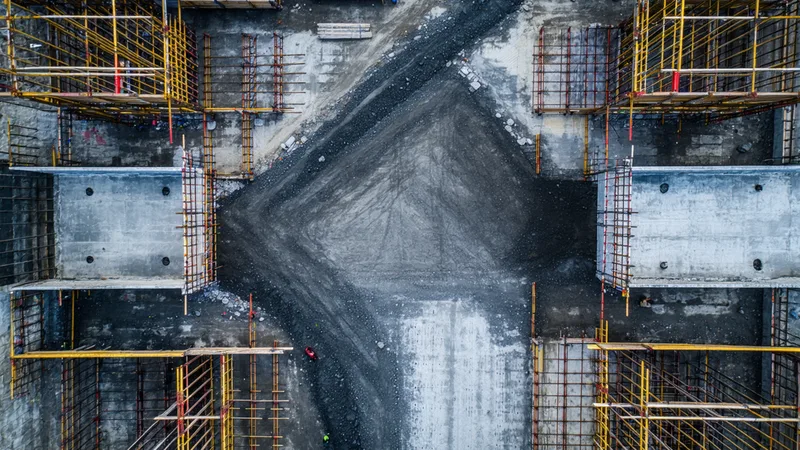
Progress Monitoring That Actually Drives Decisions
The construction industry has been talking about drone progress monitoring for years, and most mid-size GC and owner-operator programs have flown at least some drone surveys. The challenge isn't getting aerial data — it's getting aerial data frequently enough, accurately enough, and in a format that the project team actually integrates into schedule and cost management rather than using it as documentation backup after the fact.
A light commercial developer running a 12-building residential complex in the Phoenix metro area set up weekly drone surveys using a 2-aircraft program in early 2024. Twelve months later, their project manager described the experience: "We have 52 weeks of orthomosaics and we use maybe 10 of them actively. The other 42 are technically there, but we never built the workflow to integrate them into our weekly review process. The drone program is flying, the data is sitting on a server, and we're still arguing about percent complete in the Monday morning meeting based on a foreman's field walk."
That gap — between data collected and data used — is the actual challenge in construction drone monitoring programs. This guide covers mission design, deliverable format, and workflow integration for programs that want the data to drive decisions rather than fill a compliance archive.
Mission Design for Construction Sites
Construction site geometry changes between every survey flight. Unlike a static infrastructure inspection site, a construction site is an active environment where buildings are rising, earthwork is progressing, materials are staged and moved, and site access is evolving. Mission design for construction progress monitoring has to account for this dynamic geometry.
Flight Altitude and GSD for Progress Monitoring
The appropriate GSD for construction progress monitoring depends on what you're monitoring:
- Site-level progress (earthwork, structure framing, exterior cladding): 3–5 cm GSD is sufficient. This is achievable at 80–120m AGL on most multi-rotor and fixed-wing platforms and covers large sites efficiently.
- Component-level inspection (rebar placement, connection detail, concrete pour quality): Sub-1 cm GSD required. This needs to be flown at 20–30m AGL and is typically done as a targeted inspection flight of a specific structure or bay, not a full-site survey.
- Site overview for stakeholder communication: 5–10 cm GSD is fine and allows faster mission completion at higher altitude. Reserve higher-resolution passes for areas where engineering decision-making requires finer detail.
Programs that fly the entire site at maximum resolution for every weekly survey are spending 2–3× the flight time and processing capacity needed for their actual use case. Tiered mission design — high-altitude site overview for the weekly survey, targeted low-altitude passes for specific inspection needs — is more operationally efficient and produces data that's matched to the decision it needs to support.
Corridor Scan vs. Grid Survey for Linear Construction
For linear construction projects — roads, pipelines, utility corridors — a corridor scan (a series of parallel waypoints following the project centerline with defined offset width) is more efficient than a full-area grid survey. Corridor scans reduce the survey area to the active project zone, eliminating passes over areas outside the construction easement. For a road project with a 100 ft clearing width, a corridor scan covering 200 ft total width is dramatically more efficient than a grid survey of the full 1,000 ft section map.
Corridor scan missions need to account for project stage: early earthwork may have a wider active disturbance area that requires a wider corridor width, while final paving and striping may allow a narrower scan width with higher-density passes for pavement quality documentation.
Repeat Mission Consistency
Progress monitoring depends on the ability to compare survey data across dates. This requires that repeat missions follow the same flight path with the same parameters, so that position-matched image pairs from different survey dates are photographically comparable. Programs that rely on manual re-planning of each week's survey from scratch produce missions with inconsistent coverage and image geometry, making temporal comparison significantly harder. Saved mission templates — fixed flight paths that are re-flown at each survey cycle — are the standard approach for progress monitoring programs.
Ground Control and Coordinate System Alignment
Construction project coordinate systems are not always WGS84. Project survey control is typically established in a local State Plane Coordinate System (SPCS) based on the project location, with a project-specific benchmark network. Drone survey data that is processed in WGS84 and not transformed to the project coordinate system can't be overlaid on CAD design drawings or compared to traditional survey data without a coordinate transformation step.
This is a detail that many programs get wrong in their initial setup and discover after months of data collection. The fix — establishing project-referenced GCPs at the start of the drone program, with coordinates surveyed in the project coordinate system, and configuring the photogrammetry pipeline to output data in the same coordinate system — takes two to three days of setup investment. The cost of not doing it is months of unusable as-built comparison data.
For construction sites with active earthwork (grade changes between survey cycles), GCP markers need to be placed in areas that are not being actively graded. Permanent benchmarks set in concrete at the site perimeter or on permanent structures provide stable long-term control; portable targets placed in the active work area need to be GPS-surveyed at the start of each survey cycle to confirm their positions haven't shifted.
Deliverable Formats That Drive Decisions
An orthomosaic is the default output of a construction drone survey program. But an orthomosaic is a picture, not a decision tool. Converting orthomosaic data into the formats that project teams actually use in their management workflows is where most construction drone programs create or lose the value they promised.
As-Built vs. Design Overlay
The most useful deliverable for schedule management is a current survey georeferenced against the project design drawing. A utility infrastructure owner watching a 220-unit residential development can see, in a single overlay view, which building pads are at design grade, which structures are ahead of schedule, and which areas show earthwork anomalies that warrant engineering review. This requires that the drone survey output and the design drawing share a common coordinate reference — which brings us back to the GCP setup problem above.
Cut-Fill Analysis for Earthwork Projects
For sites with significant earthwork, DSM-based cut-fill analysis — comparing current surface elevation to design-grade elevation — quantifies earthwork progress and identifies over-excavation or under-excavation areas that require correction before downstream work can proceed. This is particularly valuable for mass grading operations where small grade errors on a large site can represent significant material cost. A 0.1 ft grade error over 5 acres equals approximately 2,000 cubic yards of misplaced material — the kind of issue that DSM comparison catches definitively where field stake checks only sample a fraction of the area.
Percent Complete Estimation
Calculating percent complete from aerial survey data is possible but requires a reference model — a BIM or design model that defines what "complete" looks like for each structure or work area. Programs that have BIM integration in their photogrammetry pipeline can automate structure-by-structure completion status from the orthomosaic and DSM data. Programs without BIM integration typically rely on manual overlay review, which is time-consuming and introduces subjectivity that defeats the purpose of objective aerial measurement.
Survey Frequency and Stakeholder Integration
Weekly surveys are standard for most active construction monitoring programs, but the appropriate frequency depends on project phase. Early-stage earthwork, where grade changes can be large and fast, may warrant twice-weekly surveys. Interior finish work, where exterior changes are minimal, may only justify bi-weekly or monthly surveys for the overall site, with targeted close-up passes as needed for specific component inspections.
The frequency question is really a question of decision cycle time: how often are decisions made that require current site data? A program manager who holds weekly OAC meetings and makes schedule decisions at that meeting needs data that's current as of Sunday night, not last Wednesday. A program that flies Monday afternoon and has processed data by Tuesday morning feeds the weekly meeting effectively. A program that flies Tuesday and delivers processed data Thursday misses the decision window entirely.
One pattern that works well: a Monday morning survey flight (7am, before peak site activity), with automated photogrammetry processing queued from the aircraft landing, and processed orthomosaic and DSM available in the project platform by Monday afternoon. The Monday OAC review meeting has fresh data every week. This requires a tightly integrated data pipeline, not a manual data handoff chain — but it's operationally achievable and it's the difference between drone data that drives weekly decisions and drone data that fills a archive server.
Multi-Aircraft Operations for Large Sites
Sites above 50 acres become difficult to survey in a single flight with a single multirotor within a reasonable operational window. A 100-acre active construction site at 80m AGL with 80% overlap and 70% sidelap requires approximately 45–60 minutes of flight time in good conditions with a single aircraft. Add preflight, postflight, and any battery swaps and you're at 90+ minutes for a full-site pass.
Multi-aircraft operations split the site into sectors, with each aircraft assigned a defined geographic area. Sector boundaries need to be defined carefully: sectors that share a boundary need overlapping image coverage across that boundary to enable clean mosaic stitching, typically 15–20% image overlap at sector edges. Aircraft altitude band assignments prevent airspace conflict between aircraft operating on adjacent sectors.
For a 4-aircraft site survey, the throughput improvement is roughly linear: 90-minute single-aircraft survey completes in 25–35 minutes with four aircraft, depending on sector design and transit time. The key constraint is not flight time but data processing: four aircraft produce four times the raw image volume, which requires four times the processing capacity to maintain the same data-to-deliverable turnaround time.
Construction monitoring programs that have gotten this right treat the drone program as a data pipeline management problem as much as a flight operations problem. Getting data off the aircraft quickly, into processing efficiently, and into deliverable format before the project team's next decision cycle is the operational goal. The flight itself is the easy part.